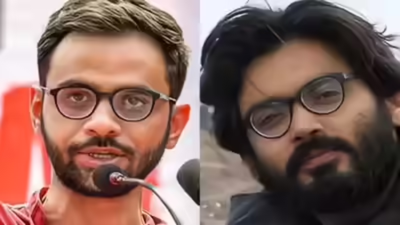
NEW DELHI: Supreme Court questioned Delhi Police Wednesday over how Section 15 of UAPA, which pertains to terrorist acts, can be invoked against Umar Khalid, Sharjeel Imam and other accused in a Delhi riots case for giving speeches and how terror acts can be linked with such speeches.A bench of Justices Aravind Kumar and N V Anjaria, which reserved its order on bail pleas of the six accused, sought a response from additional solicitor general S V Raju in light of senior advocate Siddharth Dave’s contention that at most Section 13 (unlawful activities) and Section 18 (conspiracy) could be invoked for the speeches. The ASG submitted that the riots took place because of a conspiracy hatched by the accused and whatever they had said in their speeches became reality. Raju said Imam’s speech on blocking Chicken’s Neck was an attack on the integrity of the country and Khalid’s speech on chakka jam was an attack on economic security and justified invoking Section 15.Sharjeel seems to be a punching bag: SCThe court thereafter pointed out that Delhi Police had not attributed the wielding of arms or explosives to the six accused, which is a requirement under the provision. Raju, however, said that petrol bombs were used in Delhi riots. “It is a case of conspiracy. It is not my case that they used petrol bombs. My case is that they are part of the conspiracy to create the situation for the use of petrol bombs. For use of petrol bombs, there is a separate case against other people,” he said.The bench then wrapped up the hearing, which had stretched over 11 days, and reserved its order. As the Delhi Police’s arguments were particularly focused on Imam’s speeches, which were also played in the courtroom to oppose the bail plea, and the other five accused – Umar Khalid, Gulfisha Fatima, Meeran Haider, Shadab Ahmed and Mohd Saleem Khan – had distanced themselves from him, the bench observed that Imam seemed to be a punching bag for both sides.The accused, who have been in custody for more than five years, approached the apex court after their bail plea had been rejected by Delhi High Court. Opposing their bail plea, Delhi Police accused them of indulging in regime change and told the court that they were behind “well-crafted, orchestrated, preplanned, choreographed riots” to divide the country on communal lines to achieve “the final regime change goal”.The accused, however, told the court that holding protests and opposing the govt was not an offence, and they are being prosecuted to send a message to others that anyone who raises their voice would be similarly punished. Invoking Gandhi, they said that non-violent protest and civil disobedience was a part and parcel of democracy and cannot be criminalised, as happened in the colonial era. As Delhi Police played their allegedly inflammatory speeches, the accused brought to the court’s notice clippings of their speeches in which they had talked about the constitutional spirit and responding to hate with love, to violence with non-violence and enmity with brotherhood.