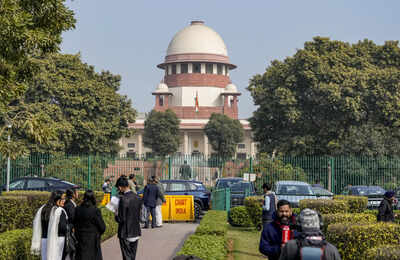
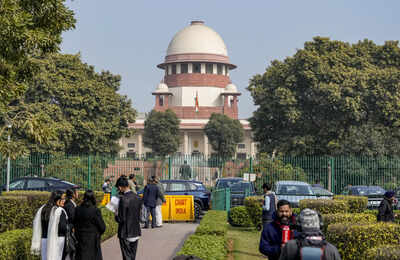
NEW DELHI: A day after Supreme Court rejected the bail plea of activists Umar Khalid and Sharjeel Imam by holding that delay in trial and long incarceration cannot be the sole ground to grant relief, another bench of the court on Tuesday held that an accused has fundamental right to speedy trial and it is not eclipsed by the nature of the offence.

It said delay in trial is a valid ground to grant bail and granted relief to former Amtek Group chairperson Arvind Dham who has been in jail for the last 16 months in a money laundering case.“The right to speedy trial, enshrined under Article 21 of Constitution, is not eclipsed by the nature of the offence,” said a bench of Justices Sanjay Kumar and Alok Aradhe. It said SC had in multiple cases invoked long incarceration to grant bail when the jail period ranged from 3-17 months.
If state can’t ensure speedy trial, don’t oppose bail plea: Supreme Court
Prolonged incarceration of an undertrial, without commencement or reasonable progress of trial, cannot be countenanced, as it has the effect of converting pretrial detention into form of punishment,” said the SC bench.Though Umar Khalid and Sharjeel Imam, who have spent almost six years in jail, are being prosecuted for terror acts under UAPA, the bail provisions — under Section 43D(5) of Unlawful Activities (Prevention) Act and Section 45 of Prevention of Money Laundering Act — are similar. Both say an accused cannot be released on bail if there are reasonable grounds for believing that the accusation against such person is prima facie true and condition is imposed under the accused to demonstrate prima facie innocence.The court’s order granting bail to former Amtek Group chairperson Arvind Dham is in contradiction to the order passed while rejecting the bail plea of the student activists but it is in conformity with orders passed by SC earlier, including in cases of former Delhi CM Arvind Kejriwal and TN minister Senthil Balaji. It shows inconsistency in the approach of the apex court.Allowing the plea of Dham, the bench said gravity of offence is one of the factors which is to be considered while deciding bail but said that statutory restrictions (as provided under PMLA, UAPA) cannot be permitted to result in indefinite pretrial detention in violation of Article 21.“It is well settled that if the State or any prosecuting agency including, the court, concerned has no wherewithal to provide or protect the fundamental right of an accused, to have a speedy trial as enshrined under Article 21 of the Constitution, then the State or any other prosecuting agency should not oppose the plea for bail on the ground that the crime committed is serious. Article 21 of the Constitution applies irrespective of the nature of the crime,” it said.“The aforesaid proposition was quoted with approval by another two-judge bench of this court and it was held that long period of incarceration for around 17 months and the trial not even having commenced, the appellant in that case has been deprived of his right to speedy trial,” the court added.The bench noted that there was no likelihood of trial being concluded in near future as there are 210 witnesses to be examined in the proceeding. “There is no likelihood of trial commencing in the near future. The continued incarceration in such circumstances, particularly where the evidence which is primarily documentary in nature, is already in custody of the prosecution, violates the right of the appellant to speedy trial under Article 21 of the Constitution of India,” it said.While allowing bail plea of UAPA accused K A Najeeb, alleged to be a member of banned PFI, Chief Justice Surya Kant, who was part of a three-judge bench and penned the judgment, had said Section 43D(5) of UAPA per se did not oust the ability of constitutional courts to grant bail on grounds of violation of fundamental rights of accused.